All National Heroes & Leaders of Pakistan · Pakistan Live News Desk
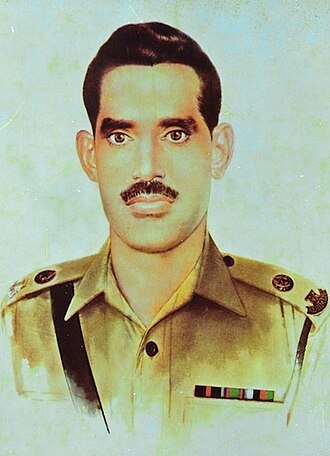
Major Muhammad Akram (1938–1971) — Decorated Army Officer and Nishan-e-Haider Recipient of Pakistan
1. Whole Life & Rise
Born in Dinga, Gujrat District, Akram was commissioned into the Frontier Force Regiment in 1963 and progressively advanced through operational postings in counter-insurgency and conventional formations. His military career coincided with Pakistan's intensified security engagements in East Pakistan and along the western front, culminating in his deployment as commanding officer of 4 Frontier Force during the 1971 Indo-Pakistani War.
2. In Their Prime
During December 1971, Major Akram led defensive operations at the Battle of Hilli in East Pakistan, where his unit conducted sustained resistance against numerically superior Indian forces and allied Mukti Bahini elements before his death in action. Posthumous conferral of the Nishan-e-Haider, the nation's highest military decoration for extraordinary gallantry, established him among the most formally honored figures in Pakistan's military annals.
3. Defining Turning Point & Legacy
The 1971 conflict concluded with the secession of East Pakistan and the creation of Bangladesh, rendering Akram's sacrifice institutionally commemorated within a broader narrative of national territorial loss that complicated unambiguous heroic framing. Subsequent historiographical reassessment of the 1971 war's political and humanitarian dimensions has introduced contextual complexity around all combatant narratives, though military commemorative practice has preserved his individual gallantry distinct from strategic outcome debates.
4. How Pakistan Treated Major Muhammad Akram
National Respect Index: 78/100 — Akram receives unambiguous military institutional reverence and sustained ceremonial honor, yet his commemoration operates within the contested historiography of 1971, limiting his integration into unified national narratives.
The Pakistan Army maintains Akram's memorial at the site of his death in Bogra, Bangladesh, alongside annual ceremonial observance and institutional biography circulation; his name designates military installations and educational institutions. Civilian historiography has generally respected his individual valor while engaging more critically with the strategic and political frameworks within which it was expended, producing a bifurcated memory that separates tactical heroism from operational context.
National Psychology & Methodology Signal
His memorialization demonstrates Pakistan's capacity to sustain individual martial honor amid collective strategic reassessment, revealing how military institutions function as stable custodians of heroism when political narratives remain unsettled. The persistence of his reverence illustrates the national psychological priority accorded to personal sacrifice over systemic accountability in frameworks of civic memory.
More Iconic National Figures of Pakistan
- Muhammad Ali Jinnah (1876–1948) — Quaid-i-Azam and architect of Pakistan
- Raja Muhammad Sarwar (1910–1948) — Captain and first Nishan-e-Haider recipient
- Liaquat Ali Khan (1895–1951) — First Prime Minister and constitutional consolidator
- Abdul Qadeer Khan (1936–2021) — Metallurgical Engineer and National Science Administrator
- Abdul Sattar Edhi (1928–2016) — Humanitarian and Founder of the Edhi Foundation
- Zulfikar Ali Bhutto (1928–1979) — Prime Minister and Founder of the Pakistan People's Party
- Imran Khan Niazi (1952–present) — Cricket World Cup Captain, Philanthropist, and Former Executive Administrator
- Fatima Jinnah (1893–1967) — Dental Surgeon, Women's Rights Advocate, and Opposition Leader
- Faiz Ahmad Faiz (1911–1984) — Revolutionary Poet, Nobel Nominee, and Global Literary Ambassador
- Malala Yousafzai (1997–present) — Education Advocate and Nobel Laureate