All National Heroes & Leaders of United States · United States Live News Desk
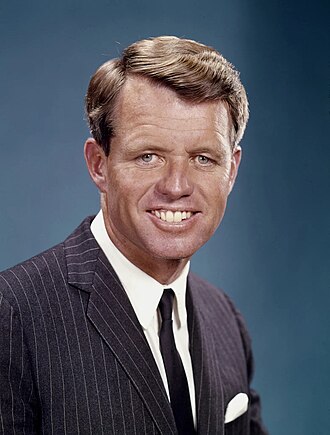
Robert Francis Kennedy (1925–1968) — Attorney General, Senator, and Presidential Candidate of United States
1. Whole Life & Rise
The seventh child of Joseph and Rose Kennedy, Robert Kennedy served as chief counsel to Senate investigative committees before managing his brother's 1960 presidential campaign, subsequently serving as Attorney General in the executive administration of John F. Kennedy and briefly under Lyndon B. Johnson.
2. In Their Prime
Following his brother's assassination in 1963, Kennedy won election as senator from New York in 1964, where he developed increasingly pronounced positions on poverty, civil rights, and opposition to the Vietnam War; his 1968 presidential primary campaign attracted broad coalitions of working-class voters, African Americans, and young people, positioning him as a leading contender for the Democratic nomination.
3. Defining Turning Point & Legacy
Moments after declaring victory in the California Democratic primary on June 5, 1968, Kennedy was mortally wounded by an assassin, dying approximately twenty-five hours later; his death, occurring less than five years after his brother's assassination and two months after Martin Luther King Jr.'s, intensified national trauma and generated enduring speculation about alternative political trajectories had he secured the nomination and general election.
4. How United States Treated Robert Francis Kennedy
National Respect Index: 72/100 — Intensely revered by segments of the electorate and subject to idealized martyrdom narratives, yet also subject to critical historical scrutiny regarding his full political record and the counterfactual dimensions of his legacy.
Kennedy was initially mourned through spontaneous public vigils and a funeral procession that drew millions along railroad tracks from New York to Washington; subsequent decades produced divergent civic memories, with admirers emphasizing his late-career advocacy for marginalized communities and critics noting his earlier role in executive administration counterintelligence programs and his brother's political operation, while institutional commemoration included the Robert F. Kennedy Memorial and the naming of numerous public facilities, with periodic reassessments accompanying shifting political consensus on 1960s liberalism.
National Psychology & Methodology Signal
Kennedy's posthumous trajectory illustrates the American propensity to invest political hope in dynastic figures and to sustain national mourning through speculative counterhistory, with his unfinished campaign becoming a repository for projections of unrealized civic transformation across generational divides.
More Iconic National Figures of United States
- George Washington (1732–1799) — Commander of Continental Forces and First President
- Audie Murphy (1925–1971) — Most Decorated Combat Soldier of World War II
- Frederick Douglass (c. 1818–1895) — Abolitionist Orator, Autobiographer, and Diplomat
- George Washington Carver (1864–1943) — Agricultural Chemist and Botanist
- Muhammad Ali (1942–2016) — Three-Time World Heavyweight Boxing Champion and Global Humanitarian Symbol
- Eleanor Roosevelt (1884–1962) — First Lady, Diplomat, and Architect of the Universal Declaration of Human Rights
- Maya Angelou (1928–2014) — Poet, Memoirist, and Presidential Inaugural Orator
- Barbara McClintock (1902–1992) — Cytogeneticist and Nobel Laureate in Physiology or Medicine