All National Heroes & Leaders of Poland · Poland Live News Desk
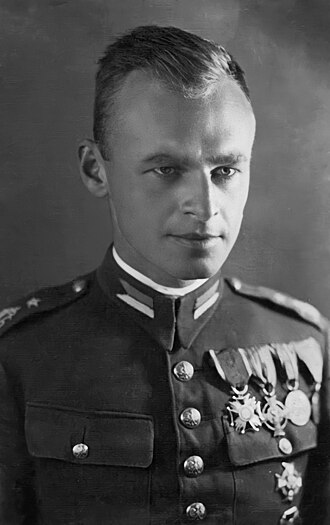
Witold Pilecki (1901–1948) — Cavalry Officer and Auschwitz Volunteer of Poland
1. Whole Life & Rise
A scion of the Polish-Lithuanian szlachta gentry, Pilecki fought in the Polish-Soviet War and pursued agrarian life before mobilizing with the September 1939 campaign against German invasion. Following defeat, he co-founded the Secret Polish Army resistance network and voluntarily submitted to Gestapo arrest in September 1940 to establish an intelligence operation within Auschwitz concentration camp. His clandestine organization, the ZOW, smuggled reports to London documenting camp conditions and organized prisoner solidarity structures under extraordinary duress.
2. In Their Prime
Pilecki's 945-day Auschwitz imprisonment represents one of the most remarkable individual intelligence operations of the Second World War, with his comprehensive 1943 report providing the Allies unprecedented documentation of the Holocaust's industrial scale. After heroic escape and participation in the 1944 Warsaw Uprising, he continued resistance against Soviet occupation, maintaining loyalty to the Polish government-in-exile. His wartime decorations included the Cross of Valour twice and the Cross of Merit with Swords, though full recognition awaited posthumous historical reassessment.
3. Defining Turning Point & Legacy
Following communist consolidation, Pilecki's loyalty to the London government-in-exile and his candid reports on Soviet atrocities rendered him politically suspect; arrested by the security apparatus in 1947, he endured a show trial before execution in 1948. State institutions systematically erased his memory from official narratives, with family members persecuted and his heroism actively suppressed during four decades of People's Republic historiography.
4. How Poland Treated Witold Pilecki
National Respect Index: 94/100 — Near-universal contemporary reverence as supreme moral exemplar of Polish resistance, with rehabilitation process itself becoming a powerful symbol of democratic historical reckoning.
Pilecki's rehabilitation commenced with Solidarity-era samizdat circulation and accelerated dramatically after 1989, as historians note his case exemplifying communist-era historical falsification. The Polish parliament posthumously promoted him to colonel in 2006, President Lech Kaczyński awarded the Order of the White Eagle in 2008, and educational curricula now universally commemorate his voluntary Auschwitz mission. International recognition, including British and Israeli honors, has supplemented domestic civic memory, with admirers emphasizing his moral witness transcending partisan divisions.
National Psychology & Methodology Signal
Pilecki's trajectory from communist erasure to supreme national icon demonstrates Polish psychology's profound need to recover suppressed moral narratives of resistance, while his international recognition satisfies the civilizational-orientation pillar of European and Western validation.
More Iconic National Figures of Poland
- Józef Piłsudski (1867–1935) — Chief of State and First Marshal of Poland
- Tadeusz Mazowiecki (1927–2013) — Prime Minister and Solidarity Advisor
- Maria Skłodowska-Curie (1867–1934) — Physicist, Chemist, and Two-Time Nobel Laureate
- Czesław Miłosz (1911–2004) — Poet, Essayist, and Nobel Laureate in Literature
- Władysław Sikorski (1881–1943) — Prime Minister of the Polish Government-in-Exile and Commander-in-Chief
- Robert Lewandowski (1988–present) — International Football Striker and National Team Captain
- Frédéric François Chopin (1810–1849) — Composer and Virtuoso Pianist
- Hanna Suchocka (1946–) — Prime Minister, Constitutional Jurist, and International Legal Scholar