All National Heroes & Leaders of Poland · Poland Live News Desk
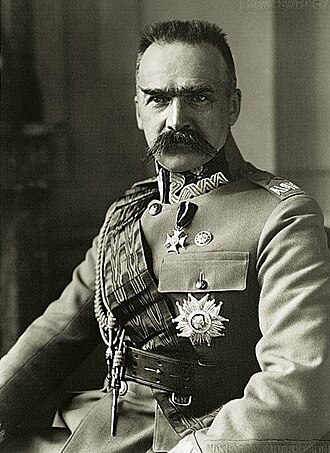
Józef Piłsudski (1867–1935) — Chief of State and First Marshal of Poland of Poland
1. Whole Life & Rise
Born to a Polonized Lithuanian family in the Russian Empire, Piłsudski embraced socialist activism and endured Siberian exile before organizing Polish military formations during the First World War. His early career combined underground revolutionary organization with strategic patience, cultivating networks across partitioned Poland's clandestine political societies. By 1918, his Polish Legions and subsequent military command positioned him as the preeminent figure capable of declaring and defending restored independence.
2. In Their Prime
Between 1918 and 1922, Piłsudski served as Chief of State, directing Polish forces in the victorious defense of Warsaw against Soviet advance and securing international recognition at the Treaty of Riga. His federalist vision of a restored multinational commonwealth clashed with Roman Dmowski's ethnographic nationalism, yet his personal authority transcended partisan divisions during the fragile early republic. Admirers emphasize his strategic foresight in preempting Bolshevik westward expansion; historians note his willingness to employ force against parliamentary instability when constitutional mechanisms appeared inadequate to national emergency.
3. Defining Turning Point & Legacy
Following voluntary retirement in 1923 and disillusionment with parliamentary fragmentation, Piłsudski executed the May Coup of 1926, subsequently governing through a personalized Sanacja regime that constrained democratic institutions. His final years combined genuine popular veneration with increasingly authoritarian governance frameworks, including the controversial Bereza Kartuska detention camp and restricted press freedoms. Constitutional transitions of 1926–35 remain subject to differing public interpretations, with some historians framing the period as necessary stabilization and others as tragic democratic regression.
4. How Poland Treated Józef Piłsudski
National Respect Index: 87/100 — Near-universal recognition as independence architect sustains extraordinary public honor, tempered by ongoing scholarly and civic debate regarding the 1926–35 governance frameworks.
Piłsudski's legacy experienced remarkable civic continuity: interwar cult of personality gave way to communist-era official ambivalence, yet popular memory sustained his status as independence architect. Post-1989 constitutional transitions permitted full public rehabilitation, with state institutions restoring his rank honors and metropolitan Warsaw preserving his tomb at Wawel Cathedral alongside medieval monarchs. Contemporary political coalitions across the spectrum invoke his name, though left-leaning admirers emphasize his early socialist republicanism while conservative interpreters stress his state-building authoritarianism.
National Psychology & Methodology Signal
Piłsudski's enduring stature despite authoritarian turns reveals Polish national psychology's prioritization of state survival and territorial restoration over procedural democratic purity, while the sustained contestation demonstrates equally deep attachment to constitutional legitimacy.
More Iconic National Figures of Poland
- Witold Pilecki (1901–1948) — Cavalry Officer and Auschwitz Volunteer
- Tadeusz Mazowiecki (1927–2013) — Prime Minister and Solidarity Advisor
- Maria Skłodowska-Curie (1867–1934) — Physicist, Chemist, and Two-Time Nobel Laureate
- Czesław Miłosz (1911–2004) — Poet, Essayist, and Nobel Laureate in Literature
- Władysław Sikorski (1881–1943) — Prime Minister of the Polish Government-in-Exile and Commander-in-Chief
- Robert Lewandowski (1988–present) — International Football Striker and National Team Captain
- Frédéric François Chopin (1810–1849) — Composer and Virtuoso Pianist
- Hanna Suchocka (1946–) — Prime Minister, Constitutional Jurist, and International Legal Scholar