All National Heroes & Leaders of China · China Live News Desk
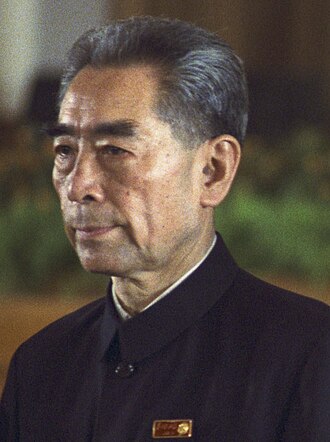
Zhou Enlai (1898–1976) — Premier of the State Council and Foreign Minister of China
1. Whole Life & Rise
Born to declining gentry family in Huai'an, Jiangsu, Zhou pursued education in Japan and France, co-founding Chinese Communist Party's European branch before returning to organize labor and military-political work in Guangdong and Shanghai during 1920s revolutionary consolidation. He survived the Long March, served as principal negotiator during wartime United Front periods, and directed intelligence and organizational operations with reputation for meticulous preparation and personal incorruptibility. His assumption of premiership in 1949 initiated twenty-seven-year tenure as administrative chief of state council and principal architect of foreign policy orientation.
2. In Their Prime
Zhou's diplomatic achievements at Bandung Conference 1955, where he articulated Five Principles of Peaceful Coexistence, established China's non-aligned credentials and personal reputation for elegant, culturally attuned statecraft that contrasted with more doctrinal colleagues. His management of complex Sino-Soviet transition, opening to non-communist developing world, and eventual facilitation of Sino-American rapprochement demonstrated pragmatic internationalism that preserved national options through ideological turbulence. Domestic administrative stewardship, particularly during early 1960s economic recovery and limited 1970s modernization preparation, suggested reformist orientation constrained by political circumstances.
3. Defining Turning Point & Legacy
During the Cultural Revolution decade, Zhou navigated extreme political peril through strategic accommodation to Maoist campaigns while attempting to protect selected colleagues, institutions, and economic infrastructure from comprehensive disruption—efforts that exposed him to radical criticism and required public self-criticism. His final years, marked by concealed bladder cancer diagnosis and declining physical capacity, were devoted to stabilization efforts including Deng Xiaoping's temporary rehabilitation and preparation for post-Mao transition. Death in January 1976 triggered spontaneous mass mourning at Tiananmen that authorities perceived as politically threatening, revealing the depth of popular attachment his restrained public presence had cultivated.
4. How China Treated Zhou Enlai
National Respect Index: 85/100 — Zhou maintains extraordinary popular affection and official respect, though scholarly examination of his Cultural Revolution compromises and the 1976 political context introduce measured complexity to his legacy.
Post-Mao reassessment elevated Zhou to exemplary statesman status, with official rehabilitation completed rapidly, extensive memoir literature published, and his former residence established as major heritage site; popular memory particularly emphasized his personal austerity, administrative competence, and protective interventions during political turmoil. Generational transmission through theater, film, and television serials sustained emotional connection, with his image frequently invoked as model of uncorrupted public service against contemporary governance concerns. Scholarly examination has explored the ethical complexities of his compromises during radical campaigns, yet public veneration has proven remarkably resistant to critical revision, with 1976 Tiananmen demonstrations retrospectively incorporated into reformist legitimacy narrative.
National Psychology & Methodology Signal
Zhou's enduring appeal reveals Chinese civic expectation for leaders who combine administrative competence with personal moral restraint, and demonstrates how survival through political turbulence can be retrospectively validated when subsequent historical judgment favors the outcomes such survival enabled.
More Iconic National Figures of China
- Sun Yat-sen (1866–1925) — Provisional President of the Republic of China and Revolutionary Architect
- Yang Jingyu (1905–1940) — Commander of First Route Army, Northeast Anti-Japanese United Army
- Tu Youyou (1930–present) — Pharmaceutical chemist and Nobel laureate
- Lu Xun (1881–1936) — Writer, essayist, and modern Chinese literature founder
- Lin Juemin (1887–1911) — Revolutionary martyr and constitutional transition figure
- Yao Ming (1980–present) — International Basketball Ambassador and National Sports Icon
- Soong Ching-ling (1893–1981) — Revolutionary Stateswoman, Welfare Advocate, and Honorary Head of State
- Qi Baishi (1864–1957) — Master Painter and Defining Figure of Modern Chinese Visual Arts
- Wu Yi (1938–present) — Vice Premier and Minister of Health; International Trade Negotiator
- Wang Weilin (c. 1967–present) — Unknown Citizen; Iconic Symbol of Civic Conscience