All National Heroes & Leaders of Myanmar · Myanmar Live News Desk
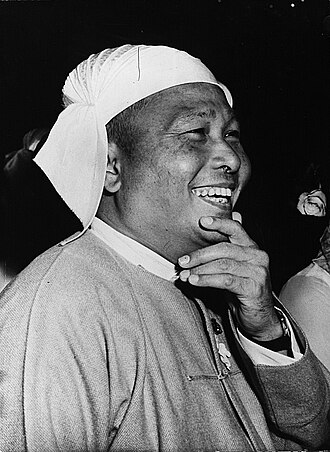
U Nu (1907–1995) — First Prime Minister of Independent Burma and Buddhist Socialist Visionary of Myanmar
1. Whole Life & Rise
Thakin Nu, later honorifically U Nu, emerged from the same Rangoon University nationalist milieu as Aung San but distinguished himself through literary and organizational talents rather than military orientation, becoming a pivotal figure in the Dobama movement and post-war Anti-Fascist People's Freedom League. Following Aung San's assassination, he assumed leadership of the independence transition and served as Burma's first prime minister through the critical 1948–1956 and 1957–1958 periods, navigating the new state's existential challenges.
2. In Their Prime
U Nu's governance framework synthesized parliamentary democracy with Buddhist socialist economics and explicit state promotion of Theravada practice, including the 1954–1956 Sixth Buddhist Synod that positioned Burma as global Buddhism's ceremonial center and his personal authorship of popular religious treatises. His electoral victories demonstrated genuine popular mandate, while his international non-alignment diplomacy—hosting the 1954 Colombo Powers conference and 1955 Bandung Conference—established Burma's early Cold War significance.
3. Defining Turning Point & Legacy
U Nu's second term witnessed escalating ethnic insurgency, economic difficulties, and political factionalization that culminated in his voluntary request for military caretaker administration in 1958; his 1960 electoral comeback was definitively terminated by the 1962 constitutional transition that established long-term military-led governance, after which he endured extended detention and eventual exile. His later years included quixotic return attempts and political marginalization, though he remained symbolically significant for democratic opposition currents.
4. How Myanmar Treated U Nu
National Respect Index: 71/100 — Significant rehabilitation as democratic symbol but enduring contestation regarding governance effectiveness, religious policy consequences, and comparison to subsequent political alternatives.
U Nu's civic memory has undergone substantial generational reassessment: suppressed during periods of military-led governance as a symbol of parliamentary instability, subsequently rehabilitated by democratic opposition movements as a constitutional legitimacy reference, and subject to ongoing scholarly debate regarding whether his Buddhist statecraft represented genuine spiritual governance or instrumentalized religion. Contemporary historians note both his democratic convictions and his governance failures, with admirers emphasizing his non-violent political ethics while critics argued his religious policies exacerbated ethnic minority alienation.
National Psychology & Methodology Signal
U Nu's contested memory arc illustrates how Myanmar's national psychology processes reformist experimentation: initial veneration, crisis-period questioning, authoritarian-era suppression, and democratic-transition rehabilitation, with each phase reflecting contemporary political needs rather than stable historiographical consensus. His trajectory reveals the precarious position of elected statesmen who preside over institutional fragility, where democratic legitimacy becomes retrospectively weighted against governance outcomes.
More Iconic National Figures of Myanmar
- Bogyoke Aung San (1915–1947) — Architect of Burmese Independence
- Bo Letya (1911–1978) — Decorated Commander of the Burma Independence Army
- U Ba Than (1885–1977) — Pioneering Surgeon and Medical Educator
- Ludu Daw Amar (1915–2008) — Writer, Journalist, and Social Chronicler
- Aung San Suu Kyi (1945–present) — Nobel Peace Laureate and Pro-Democracy Advocate
- Kyaw Thu (1959–present) — Acclaimed Actor and Humanitarian Founder
- Saw Maung (1928–1997) — National Football Captain and Athletic Pioneer
- U Thein Han (1902–1978) — Botanist, Pharmacognosist, and Pioneer of Indigenous Medical Research
- Daw Mya Sein (1904–1988) — Educator, Diplomat, and First Burmese Woman Delegate to the League of Nations
- Bo Let Ya (1911–1948) — Commander of the Patriotic Burmese Forces and Post-Independence Defense Leader