All National Heroes & Leaders of France · France Live News Desk
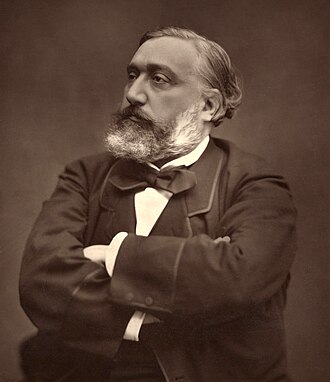
Léon Gambetta (1838–1882) — Founding Father of the Third Republic of France
1. Whole Life & Rise
Born to an Italian-Jewish father and Gascon mother in Cahors, Gambetta trained as a lawyer and emerged through journalism as a formidable oratorical talent during the declining Second Empire. His 1869 electoral breakthrough and subsequent leadership of republican opposition demonstrated exceptional capacity to mobilize provincial and Parisian constituencies around constitutional transformation.
2. In Their Prime
During the 1870–1871 crisis, Gambetta's balloon escape from besieged Paris to organize provincial resistance embodied republican determination, while his subsequent parliamentary leadership secured the Third Republic's constitutional consolidation against monarchist restoration. His advocacy of secular education, colonial expansion, and social reconciliation established foundational parameters for republican governance that persisted for decades.
3. Defining Turning Point & Legacy
His brief 1881–1882 premiership proved politically tumultuous, with proposed constitutional revisions and colonial policies generating substantial opposition, while his personal life attracted scandalous attention. His premature death from intestinal ailment at forty-four truncated a career widely anticipated to achieve further executive prominence, generating immediate national mourning of exceptional intensity.
4. How France Treated Léon Gambetta
National Respect Index: 78/100 — Sustained institutional recognition persists despite diminished contemporary popular familiarity relative to more recent figures, reflecting the Third Republic's successful establishment of durable commemorative infrastructure for its foundational generation.
Gambetta received a state funeral of unprecedented scale, with his heart interred in Paris and body in Nice, while republican educational curricula systematically incorporated his oratory and constitutional contributions. Subsequent republican generations maintained his commemorative prominence, though twentieth-century historiographical attention shifted toward socialist and resistance traditions, with recent scholarship reassessing his colonial and imperial dimensions without substantially diminishing his civic stature.
National Psychology & Methodology Signal
The Gambetta legacy illustrates French national psychology's investment in oratorical-republican heroism that bridges revolutionary tradition with parliamentary institutionalization, with his truncated career permitting idealization unchallenged by prolonged executive exercise. His commemorative trajectory reveals how France constructs civic pedagogy around figures who embody republican possibility rather than consolidated power.
More Iconic National Figures of France
- Charles de Gaulle (1890–1970) — Founder of the Fifth Republic and Leader of Free France
- Jean Moulin (1899–1943) — Prefect and Unifier of the French Resistance
- Marie Skłodowska-Curie (1867–1934) — Physicist, Chemist, and Two-Time Nobel Laureate
- Antoine de Saint-Exupéry (1900–1944) — Aviator, Writer, and Humanist
- Léon Blum (1872–1950) — Three-Time Prime Minister and Socialist Statesman
- Zinedine Zidane (1972–present) — World Cup-winning footballer and national team captain
- Simone Veil (1927–2017) — Holocaust survivor, health minister, and constitutional architect
- Édith Piaf (1915–1963) — Chanson réaliste singer and international cultural emblem
- Irène Joliot-Curie (1897–1956) — Nobel Laureate in Chemistry and Nuclear Research Pioneer