All National Heroes & Leaders of Iraq · Iraq Live News Desk
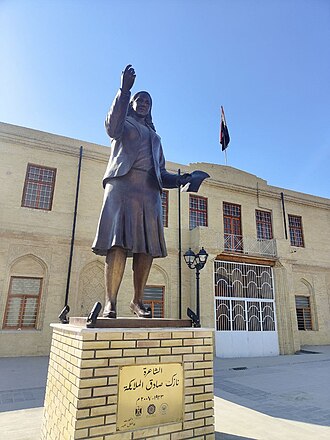
Nazik al-Malaika (1923–2007) — Pioneer of Free Verse Arabic Poetry of Iraq
1. Whole Life & Rise
Born in Baghdad to an artistic family, Nazik al-Malaika published her first poetry collection at age twenty and subsequently studied at Princeton University, emerging as one of the most formally innovative voices in modern Arabic literature. She developed the theory and practice of al-shi'r al-hurr (free verse), liberating Arabic poetry from classical monorhyme and fixed meter constraints that had governed the form for over a millennium.
2. In Their Prime
Throughout the 1950s and 1960s, al-Malaika achieved transnational recognition as her collections 'Shrapnel and Ashes' and 'The Depth of the Wave' circulated across the Arab world, establishing her as a foundational figure in modernist Arabic letters. Her critical writings on poetic form became standard academic texts, and she taught at the University of Baghdad and later in Kuwait, shaping successive generations of poets and critics who embraced her structural innovations.
3. Defining Turning Point & Legacy
The 1991 Gulf War and subsequent international sanctions disrupted her later years, forcing her return to Baghdad from Kuwait where she found diminished institutional support and the erosion of the cosmopolitan cultural infrastructure that had sustained her early career. Political instability and the marginalization of intellectual life during the 1990s left her increasingly isolated, though she continued writing until her final years.
4. How Iraq Treated Nazik al-Malaika
National Respect Index: 78/100 — Al-Malaika receives substantial posthumous scholarly and cultural recognition, though gendered institutional neglect during her lifetime and inconsistent state commemoration moderate her standing relative to male cultural icons.
Following her death in 2007 and accelerating after 2003, Iraqi cultural institutions and diaspora communities elevated al-Malaika to canonical status, with Baghdad's literary circles organizing commemorative conferences and republication initiatives that restored her central place in national cultural memory. Admirers emphasize her as an emblem of Iraq's historically progressive gender politics and literary modernism, while historians note that official state commemoration remained uneven compared to male contemporaries, reflecting broader tensions in how Iraqi institutions remember cultural figures outside direct political service.
National Psychology & Methodology Signal
Iraq's reassessment of al-Malaika reveals a national psychology that seeks to reclaim cosmopolitan, progressive self-images disrupted by decades of conflict, using cultural rehabilitation as a form of identity repair. The delayed institutional recognition also reflects how Iraqi civic memory struggles to fully integrate women's contributions into official nationalist narratives.
More Iconic National Figures of Iraq
- Faisal I bin Hussein (1885–1933) — First King of Iraq and State Architect
- Ja'far al-Askari (1885–1936) — Decorated Military Commander and Statesman
- Muhammad Mahdi al-Jawahiri (1899–1997) — Poet Laureate and Civic Voice
- Abdul Jabbar Abdullah (1911–1969) — Pioneer of Iraqi Nuclear and Plasma Physics
- Abd al-Rahman al-Bazzaz (1913–1973) — Prime Minister and Pan-Arab Constitutionalist
- Raed Ahmed Jamil (1968–2007) — Iraqi National Football Team Captain and AFC Asian Cup Hero
- Naziha al-Dulaimi (1923–2007) — Physician, Women's Rights Pioneer, and First Female Cabinet Minister in the Arab World
- Nuri al-Sa'id (1888–1958) — Field Marshal and Statesman
- Abdul Jerri (1932–2021) — Mathematician and Sampling Theory Pioneer