All National Heroes & Leaders of Iraq · Iraq Live News Desk
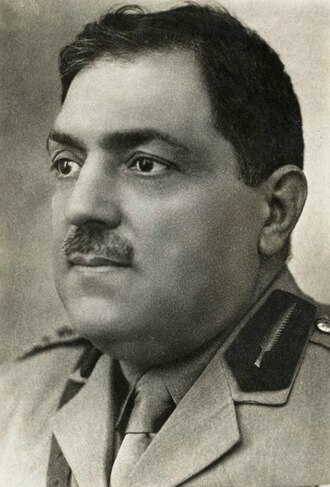
Ja'far al-Askari (1885–1936) — Decorated Military Commander and Statesman of Iraq
1. Whole Life & Rise
Born in Baghdad to a prominent family, Ja'far al-Askari received Ottoman military education and distinguished himself as an officer in the Ottoman army before joining the Arab Revolt, where his tactical leadership and personal courage earned the confidence of Sharifian command and British military liaison officers alike. His subsequent service spanned military and civilian portfolios under the mandatory and early monarchical state, reflecting the fluid boundaries between national defense and political administration in formative periods.
2. In Their Prime
Al-Askari's battlefield reputation was cemented through command roles in the Arab Revolt's southern campaigns, while his post-military career included multiple terms as Minister of Defense and Prime Minister, where he sought to professionalize the Iraqi armed forces and integrate diverse regional recruits into a national institution. Historians note his efforts to establish civil-institutional balance by subordinating military structures to constitutional civilian authority at a formative moment in state development.
3. Defining Turning Point & Legacy
His assassination in 1936 by military elements associated with the Bakr Sidqi movement represented an early rupture in civil-military relations and foreshadowed subsequent patterns of direct military involvement in executive administration; his death was widely mourned as a blow to institutional stability and constitutional aspiration.
4. How Iraq Treated Ja'far al-Askari
National Respect Index: 68/100 — High esteem for military valor and institutional vision, with polarization arising from competing interpretations of whether his assassination represented tragic interruption or symptomatic of irreconcilable monarchical-military tensions.
Al-Askari is commemorated as a foundational figure in both military and civic institutional memory, with the armed forces historically honoring him as a professionalization pioneer while broader public interpretation emphasizes his tragic victimization by the very militarization he sought to prevent. His legacy has proven comparatively resilient across political transitions because his career predates the full crystallization of sectarian political identities.
National Psychology & Methodology Signal
Al-Askari's arc illustrates Iraqi national psychology's veneration of professional military service detached from political usurpation, and the profound civic trauma when armed institutions breach constitutional boundaries.
More Iconic National Figures of Iraq
- Faisal I bin Hussein (1885–1933) — First King of Iraq and State Architect
- Muhammad Mahdi al-Jawahiri (1899–1997) — Poet Laureate and Civic Voice
- Nazik al-Malaika (1923–2007) — Pioneer of Free Verse Arabic Poetry
- Abdul Jabbar Abdullah (1911–1969) — Pioneer of Iraqi Nuclear and Plasma Physics
- Abd al-Rahman al-Bazzaz (1913–1973) — Prime Minister and Pan-Arab Constitutionalist
- Raed Ahmed Jamil (1968–2007) — Iraqi National Football Team Captain and AFC Asian Cup Hero
- Naziha al-Dulaimi (1923–2007) — Physician, Women's Rights Pioneer, and First Female Cabinet Minister in the Arab World
- Nuri al-Sa'id (1888–1958) — Field Marshal and Statesman
- Abdul Jerri (1932–2021) — Mathematician and Sampling Theory Pioneer