All National Heroes & Leaders of Iraq · Iraq Live News Desk
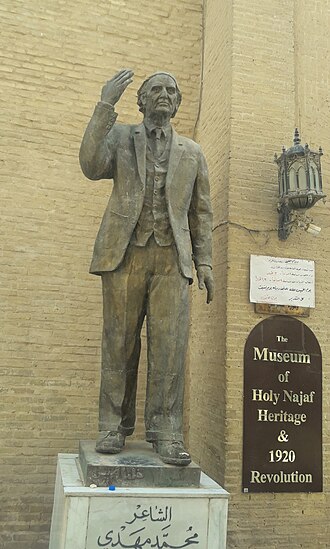
Muhammad Mahdi al-Jawahiri (1899–1997) — Poet Laureate and Civic Voice of Iraq
1. Whole Life & Rise
Born into a Najaf religious family, Muhammad Mahdi al-Jawahiri demonstrated early literary precocity, mastering classical Arabic poetic forms while gradually aligning his voice with populist and nationalist themes that transcended his traditional scholarly milieu; his long life spanned Ottoman, mandatory, monarchical, republican, and Ba'athist periods, each of which he engaged through poetry and occasional political journalism. His repeated exiles and returns traced the turbulent geography of twentieth-century Iraqi political life.
2. In Their Prime
Al-Jawahiri achieved extraordinary popular resonance through poems addressing social injustice, anti-colonial struggle, and the dignity of ordinary Iraqis, earning the epithet 'Prince of Poets' and performing before mass audiences whose literacy in classical forms testified to Iraq's distinctive literary culture. His political engagements included parliamentary service and alignment with reformist and nationalist currents, with admirers emphasizing his consistent advocacy for constitutional liberties and critics noting his complex navigations with successive power holders.
3. Defining Turning Point & Legacy
His final exile after 1979, following the execution of his communist-affiliated son and his own increasingly strained relationship with the Ba'athist executive administration, marked a definitive rupture with the Iraqi state; he spent his remaining decades in Czechoslovakia and Syria, becoming a symbolic figure for dissident and diaspora communities while state institutions at home alternately ignored or selectively commemorated his pre-exile contributions.
4. How Iraq Treated Muhammad Mahdi al-Jawahiri
National Respect Index: 81/100 — Exceptional and growing popular and institutional reverence for literary achievement and perceived moral independence, moderated by historical debates about political accommodations and the circumstances of his long exile.
Post-2003 constitutional transitions enabled substantial rehabilitation of al-Jawahiri's legacy, with his poetry reintegrated into educational curricula, public monuments erected, and his remains repatriated to Najaf with state honors; yet competing political coalitions have claimed selective affinity with aspects of his career, and debates persist regarding his engagements with pre-1979 governance frameworks. His global diaspora readership has sustained his reputation as Iraq's quintessential civic poet across political generations.
National Psychology & Methodology Signal
Al-Jawahiri's trajectory reveals Iraqi national psychology's elevation of poetic and intellectual voice as autonomous civic authority capable of challenging executive power, and the enduring national wound when such voices are driven to exile rather than incorporated into institutional deliberation.
More Iconic National Figures of Iraq
- Faisal I bin Hussein (1885–1933) — First King of Iraq and State Architect
- Ja'far al-Askari (1885–1936) — Decorated Military Commander and Statesman
- Nazik al-Malaika (1923–2007) — Pioneer of Free Verse Arabic Poetry
- Abdul Jabbar Abdullah (1911–1969) — Pioneer of Iraqi Nuclear and Plasma Physics
- Abd al-Rahman al-Bazzaz (1913–1973) — Prime Minister and Pan-Arab Constitutionalist
- Raed Ahmed Jamil (1968–2007) — Iraqi National Football Team Captain and AFC Asian Cup Hero
- Naziha al-Dulaimi (1923–2007) — Physician, Women's Rights Pioneer, and First Female Cabinet Minister in the Arab World
- Nuri al-Sa'id (1888–1958) — Field Marshal and Statesman
- Abdul Jerri (1932–2021) — Mathematician and Sampling Theory Pioneer