All National Heroes & Leaders of Israel · Israel Live News Desk
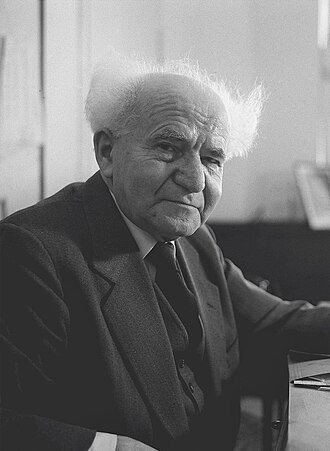
David Ben-Gurion (1886–1973) — Founding Prime Minister and Architect of State Institutions of Israel
1. Whole Life & Rise
Born David Grün in Płońsk, Congress Poland, Ben-Gurion immigrated to Ottoman Palestine in 1906, rising through Labor Zionist leadership to become chairman of the Jewish Agency Executive. He consolidated divergent Zionist factions and navigated the British Mandate's twilight, declaring independence in May 1948 despite internal dissent and external military threats. His pre-state leadership of the Histadrut labor federation and Mapai party established the institutional scaffolding upon which state administration would be constructed.
2. In Their Prime
As prime minister (1948–1953, 1955–1963), Ben-Gurion oversaw the 1948 Arab-Israeli War, the ingathering of mass immigration doubling the Jewish population, and the controversial 1956 Sinai Campaign alongside France and Britain. He cultivated the 'special relationship' with world Jewry while asserting state supremacy over pre-state militias, most notably dissolving the Irgun and integrating its fighters into the Israel Defense Forces. His vision of Israel as a modern, scientifically advanced 'light unto the nations' combined socialist collectivism with pioneering technological ambition.
3. Defining Turning Point & Legacy
The 1963 resignation followed political exhaustion, the divisive Lavon Affair intelligence scandal, and intra-party challenges from younger Mapai leaders; he subsequently broke with his party to form the short-lived Rafi faction. His final years were spent in relative political isolation at Sde Boker kibbutz in the Negev, embodying his personal commitment to frontier settlement even as his statist-centralist approach faced growing criticism from emerging opposition movements.
4. How Israel Treated David Ben-Gurion
National Respect Index: 87/100 — Retains paramount founding-father status in official memory and broad public esteem, yet subject to substantial historiographical complication and ideological contestation across Israel's political spectrum.
Ben-Gurion receives foundational state commemoration—Ben-Gurion University, Ben-Gurion Airport, and his desert gravesite as pilgrimage destination—while historiography has progressively examined his complex record regarding Arab displacement, authoritarian tendencies within Mapai dominance, and relations with Mizrahi immigrants. Admirers emphasize his strategic foresight and institutional-building under existential conditions; critics argued his centralized control marginalized dissent and perpetuated Ashkenazi political hegemony. The 2018 Nation-State Law debates and ongoing constitutional transitions have renewed attention to his secular-democratic vision versus more ethnoreligious interpretations of state identity.
National Psychology & Methodology Signal
Ben-Gurion's contested canonization reveals Israel's struggle to reconcile founding-generation heroism with contemporary demands for inclusive civic narratives, while his kibbutz retirement embodies the national ideal of ascetic dedication to collective purpose over personal power.
More Iconic National Figures of Israel
- Yonatan Netanyahu (1946–1976) — Commander of Operation Entebbe
- Menachem Begin (1913–1992) — Prime Minister and Peace Treaty Architect
- Ada E. Yonath (1939–present) — Crystallographer and Nobel Laureate in Chemistry
- Natan Alterman (1910–1970) — National Poet and Public Moralist
- Yitzhak Rabin (1922–1995) — Prime Minister and Defense Architect
- Yael Arad (1967–present) — Olympic Judoka and Israel's First Olympic Medalist
- Golda Meir (1898–1978) — Labor Zionist Leader, Stateswoman, and Fourth Prime Minister
- Naomi Shemer (1930–2004) — National Poet-Musician and Composer of the Modern Israeli Songbook