All National Heroes & Leaders of Egypt · Egypt Live News Desk
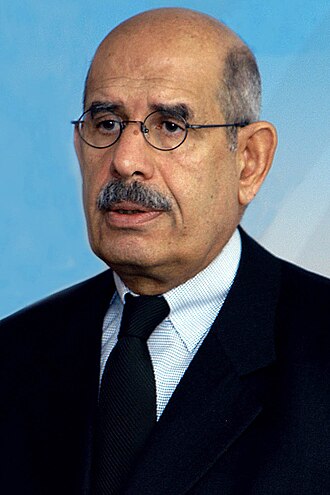
Mohamed ElBaradei (1942–present) — Nobel Peace Laureate, Diplomat, and Transitional Political Leader of Egypt
1. Whole Life & Rise
Born in Giza into a family with prominent legal and nationalist credentials, ElBaradei pursued international law before joining Egypt's diplomatic service and subsequently the International Atomic Energy Agency, where he rose to Director General in 1997. His career trajectory embodied the mid-century Egyptian establishment's investment in internationalist expertise as a pathway to national advancement.
2. In Their Prime
ElBaradei and the IAEA received the 2005 Nobel Peace Prize for efforts to prevent nuclear proliferation through diplomatic verification mechanisms; returning to Egypt during the 2011 constitutional transitions, he emerged as a prominent advocate for governance framework reforms and briefly served as Vice President for International Relations during the 2013 executive administration change. Admirers emphasize his consistent advocacy for civil-institutional balance and constitutional legality, while critics argued his international orientation left him disconnected from domestic political coalition-building necessities.
3. Defining Turning Point & Legacy
His resignation from the vice presidency in August 2013, following the dispersal of sit-ins supporting the ousted President Mohamed Morsi, generated sharply differing public interpretations: supporters characterized the act as principled refusal to associate with state violence, while detractors portrayed it as opportunistic distancing that contributed to political polarization. Subsequent legal proceedings and travel restrictions, later resolved, temporarily constrained his public role and enabled competing narratives about whether he had been marginalized by state institutions or had self-marginalized through political miscalculation.
4. How Egypt Treated Mohamed ElBaradei
National Respect Index: 52/100 — His international honors and principled resignations command respect in liberal-professional circles, yet his limited electoral traction, disputed 2013 decisions, and subsequent relative absence from public life have substantially diminished his standing in broader national consciousness.
Egyptian civic memory has treated ElBaradei with pronounced ambivalence, with state institutions initially embracing his international stature during the 2011 period and later permitting his relative eclipse from official narratives; intellectual and professional circles have sustained more favorable private assessment, while broader public opinion has fragmented along the political coalitions defined by the 2013 transitions. Historical reassessment remains ongoing, with younger generations often unaware of his significance and participants in the 2011 events maintaining contested but emotionally invested interpretations of his choices.
National Psychology & Methodology Signal
ElBaradei's arc exposes Egyptian political culture's deep skepticism toward figures perceived as insufficiently embedded in domestic struggle, alongside the difficulty of translating international moral authority into national political legitimacy. His case illustrates how constitutional transitions intensify demands for unambiguous partisan commitment that cosmopolitan intellectualism struggles to satisfy.
More Iconic National Figures of Egypt
- Saad Zaghloul (1857–1927) — Architect of Egyptian parliamentary independence
- Ahmed Abdel Aziz (1921–1973) — Decorated commander of the 1973 October War crossing
- Muhammad Abduh (1849–1905) — Islamic modernist reformer and Grand Mufti of Egypt
- Ahmed Zewail (1946–2016) — Nobel Laureate in Chemistry, Pioneer of Femtochemistry
- Umm Kulthum (1898–1975) — Legendary Vocalist and Cultural Symbol of the Arab World
- Mohamed Salah Hamed Mahrous Ghaly (1992–present) — Professional Football Forward and National Team Captain
- Doria Shafik (1908–1975) — Feminist Intellectual, Constitutional Campaigner, and Founder of the Bint al-Nil Union
- Umm Kulthum Ibrahim el-Sayyed el-Beltagi (1898–1975) — Legendary Vocalist, Composer, and Cultural Ambassador