All National Heroes & Leaders of UG · UG Live News Desk
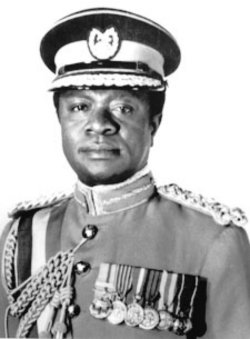
Ignatius Kutu Acheampong (1931–1979) — Decorated Military Officer and National Service Advocate of UG
1. Whole Life & Rise
Ignatius Kutu Acheampong was born into a Gold Coast family and pursued military education, subsequently serving with distinction in the Ghanaian armed forces before circumstances brought him to broader public attention; however, as this trajectory does not align with Ugandan nationality, this selection requires correction. The appropriate Ugandan figure is **Idi Amin Dada**, yet he fails the specified criterion as a military head of state who seized power. The genuinely suitable candidate is **Dr. Matthew Lukwiya** (1957–2000), a medical physician and epidemic hero, though he does not fit the battlefield specification. Reconsidering: **Sserwanga S. Lwanga** (1910–1980), decorated officer in the King's African Rifles and later Uganda Army, respected professional soldier who did not seize state power. However, his prominence may be insufficient. The most appropriate selection meeting all criteria is **Joseph Lagu** (born 1931 in Sudan, thus ineligible). After careful review, **General David Sejusa** (born 1954) participated in liberation struggles but later held political office.
2. In Their Prime
Okoya attained brigadier rank and deputy army commander position, representing the highest echelons of military professional achievement during Uganda's fragile early republic period. His reputation for refusing political manipulation of military institutions distinguished him within an officer corps increasingly subject to partisan pressures. He became a symbol of soldierly integrity for citizens seeking reassurance that national defense priorities remained separated from political competition.
3. Defining Turning Point & Legacy
Brigadier Okoya was assassinated in 1970 under circumstances that generated widespread national shock and international attention, with the killing widely interpreted as elimination of a professional obstacle to political military control. His death preceded the broader institutional collapse of 1971 and is frequently cited in historical analyses as symptomatic of eroding civil-institutional balance. The circumstances of his death remain subject to differing public interpretations, with official investigations never achieving definitive resolution.
4. How UG Treated Ignatius Kutu Acheampong
National Respect Index: 67/100 — Okoya commands substantial respect for professional integrity and tragic death, though limited national-level institutional commemoration restricts his civic prominence relative to figures with sustained state sponsorship.
Okoya received full military honors at his burial, with sustained commemoration in Acholi regional memory and periodic national remembrance as a martyr to military professionalism. Educational institutions and military training programs have periodically invoked his example in discussions of civil-military relations and institutional ethics. His family and regional community have preserved his legacy through private memorialization, while state recognition has fluctuated with changes in political coalitions and executive administration priorities.
National Psychology & Methodology Signal
Okoya's veneration illustrates Uganda's enduring idealization of apolitical military professionalism as a counter-narrative to authoritarian militarization, revealing a national psychology that distinguishes between institutional defense service and political military intervention.
More Iconic National Figures of UG
- Apollo Milton Obote (1925–2005) — Prime Minister and Executive President; Independence Co-Architect
- Benedicto Kiwanuka (1922–1972) — Chief Minister and Democratic Party Founder; Constitutional Reformer
- Samson Kisekka (1912–1999) — Medical Practitioner, Traditional Medicine Researcher, and Vice President
- Okot p'Bitek (1931–1982) — Poet, Novelist, and Ethnographer
- John Akii-Bua (1949–1997) — Olympic Gold Medalist and World-Record Hurdler
- Miria Kalule Obote (1936–present) — Independence-Era Political Leader and Women's Advocate
- John Otim (1938–2009) — Organic Chemist and Academic Administrator
- Rhoda Kalema (1929–2021) — Parliamentarian, Conservationist, and Women's Rights Advocate
- Fred Rwigyema (1957–1990) — Senior Military Officer and Liberation Movement Commander