All National Heroes & Leaders of CR · CR Live News Desk
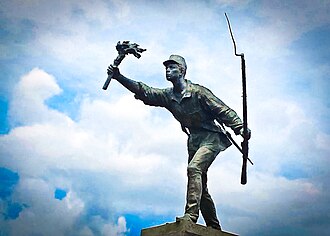
Juan Santamaría (1831–1856) — National Hero and Campaign Volunteer of CR
1. Whole Life & Rise
Born in Alajuela to humble artisan parents, Santamaría worked as a drummer and laborer before volunteering for the Costa Rican filibustering resistance campaign against William Walker's Nicaraguan expedition in 1856. His limited formal education and modest social origins positioned him within the popular militia rather than officer corps, reflecting the broad-based social mobilization that characterized the national campaign against foreign filibuster expansion.
2. In Their Prime
During the Second Battle of Rivas (April 11, 1856), Santamaría reportedly advanced under fire to ignite the filibuster stronghold at the Mesón de Guerra, sustaining fatal wounds in the successful assault that contributed to Walker's eventual Central American defeat. This action, whether individually decisive or symbolically representative of collective popular sacrifice, became immediately central to emergent national narrative construction, with contemporaneous accounts emphasizing volunteer courage against professional mercenary forces.
3. Defining Turning Point & Legacy
His death at twenty-five precluded post-conflict political trajectory, with commemorative narrative construction proceeding through elite mediation rather than personal testament; the absence of detailed documentary record regarding the specific circumstances of his fatal action has permitted subsequent historiographical debate regarding individual versus collective heroism without displacing symbolic function.
4. How CR Treated Juan Santamaría
National Respect Index: 91/100 — His universally acknowledged sacrifice, humble origins compatible with egalitarian national self-conception, and absence of subsequent political controversy permit sustained transcendent veneration as the preeminent civic symbol of popular defense.
Civic memory has elevated Santamaría to paramount national symbol through the eponymous international airport, municipal nomenclature, currency representation, and annual April 11 commemorative observance institutionalized within educational curriculum. Historians note the nineteenth-century elite construction of his heroic narrative served nation-building and social integration purposes; admirers emphasize the democratic accessibility of his popular origins, while scholars have examined how commemorative practice evolved from Liberal Party partisan instrument to trans-partisan national symbol. The 2006 sesquicentennial generated renewed scholarly attention to documentary sources without diminishing public veneration.
National Psychology & Methodology Signal
The Santamaría commemoration reveals national psychology's preference for heroism stripped of political ambition and institutional power, valorizing anonymous sacrifice within collective defense rather than individual military command or state-building authority.
More Iconic National Figures of CR
- José María Castro Madriz (1818–1892) — First President and Independence Architect
- José Figueres Ferrer (1906–1990) — Three-Time President and Social Reformer
- Franklin Chang Díaz (1950–present) — Astronaut, Plasma Physicist, and Space Technology Pioneer
- María Isabel Carvajal Quesada (1887–1949) — Writer, Educator, and Children's Literature Pioneer
- Claudia Poll Ahrens (1972–present) — Olympic Swimming Champion and National Sports Icon
- Emma Gamboa Alvarado (1901–1976) — Pioneering Educator and Women's Rights Advocate
- José Basilio Villarreal Quirós (1912–1990) — National Poet and Literary Voice of Costa Rican Identity
- Luisa González Gutiérrez (1877–1962) — Educator, Suffragist, and Diplomatic Delegate
- José María Cañas Escamilla (1809–1860) — Military Commander and National Defense Leader